Opto-mechanics: Beam Combiners
Beam Combiners for Laser Alignment and Beam Merging
Beam combiners for merging laser and alignment beams at 45° AOI, in standard, reverse and ZnSe CO2 versions. Request a quote from Wavelength Optics USA today.
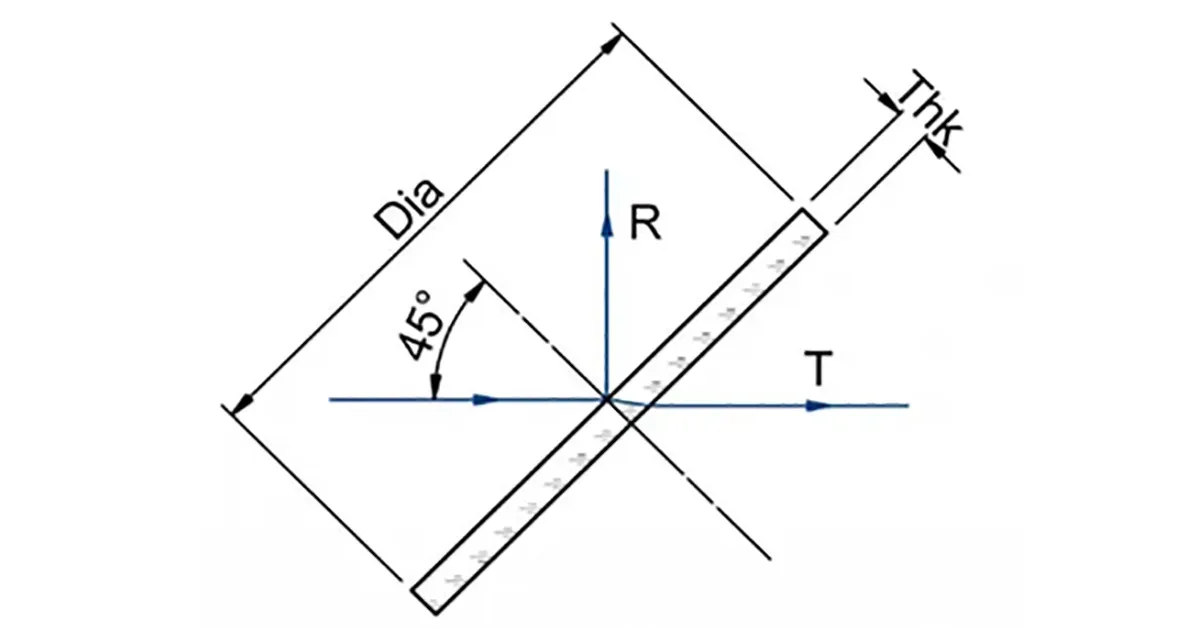
Design angle of incidence
Surface quality
Transmit/reflect configurations
Option for CO2 laser alignment
Full catalogue
0 matching parts
| Part Number▲ | Wavelength (nm)▲ | Material▲ | Dimension (mm)▲ | Thickness (mm)▲ |
|---|
No parts match these filters. .
Beam combiners merge two or more laser beams into a single beam path. They are used mainly for system alignment, where a visible beam must travel the same path as the working beam. Each combiner is designed for a 45° angle of incidence. It transmits one wavelength straight through and reflects a second wavelength into the same output axis. Whether you’re bringing a visible pointer onto the axis of an infrared processing laser or combining two sources in a scanning system, the combiner lets you place both beams on one line without separate alignment hardware.
Standard, reverse and multi-wavelength configurations
The configuration you need depends on which wavelength passes through the optic and which one is reflected.
- Standard beam combiners transmit the longer-wavelength beam and reflect the shorter-wavelength beam. Examples in the catalogue include 1064T/650R and 808T/1064R type pairings, plus other combinations listed in the spec table.
- Reverse beam combiners transmit the shorter wavelength and reflect the longer one. Pairings such as 650T/1064R and 650T/1550R suit layouts where the visible alignment beam has to go straight through and the working laser comes in from the side.
- Multi-wavelength beam combiners transmit or reflect more than two wavelength beams. They are intended for systems that carry several sources on one axis.
- ZnSe beam combiners are designed for CO2 laser alignment. The 10600T / 650R configuration transmits the CO2 beam and combines it with a visible alignment beam reflected at 90°.
Substrates include fused silica, N-BK7 and ZnSe. The material is matched to the wavelength pair. The spec table below lists every available part number with its wavelength pairing, material, dimension and thickness, so you can filter for your source combination.
Where beam combiners are used
Laser engraving and marking. Engraving systems often run an invisible infrared or UV source. A combiner puts a visible beam on the same path, so operators can see where the beam will land and set up parts before firing.
Laser welding. In welding heads and beam delivery systems, a co-aligned visible beam helps you position the joint and confirm the beam path after maintenance or optic changes.
Medical laser treatment. Many therapeutic and surgical lasers work outside the visible range. An aiming beam combined onto the treatment path shows the clinician where energy will be delivered.
Laser scanning. In scanning systems, combining sources ahead of the galvo or scan optics keeps every wavelength on a shared axis through the rest of the optical train.
General system alignment. In OEM integration and lab setups, a combiner is a simple way to commission and recheck an optical path with a visible reference.
Customization and buying through Wavelength Optics USA
The catalogue covers a range of common wavelength pairings. If your system uses a combination that isn’t listed, or needs a different size, thickness or substrate, the combiners can be customized. Send your requirements through the RFQ form and include the wavelengths to be transmitted and reflected, the material, the clear aperture or outer dimension, and the mounting constraints.
Buying through Wavelength Optics, the US arm of Wavelength Opto-Electronic, gives you:
- Local support. You work with a US-based team in your own time zone and business conventions.
- Fast quoting. Standard and custom requests go through the US entity, with a direct line back to the manufacturing team in Singapore.
- Technical consultation on selection. We can help you choose between standard and reverse configurations, confirm a substrate for your wavelengths, and check how the combiner fits with related optics such as dichroic mirrors, beam expanders, scan lenses and CO2 optics.
If you’re specifying a beam combiner for a new design or replacing one in an existing system, send us your wavelengths and geometry and we’ll help you select the right part.
Need Help Choosing the Right Model?
Our photonics specialists can help you select the optimal configuration for your system. Custom specifications available on request.