Imaging Lenses
Aspheric Lenses: Aberration-Correcting Optics for Laser Systems
Aspheric lenses that correct spherical aberration with fewer elements, in fused silica, silicon, germanium and ZnSe. Request a quote from Wavelength Optics USA.
Focal length tolerance
Centration
Irregularity P-V
AR coating per surface @ 1030-1090nm
Full catalogue
0 matching parts
| Part Number▲ | Wavelength (nm)▲ | EFL (mm)▲ | Dia (mm)▲ | Material▲ | ET (mm)▲ | CT (mm)▲ | BFL (mm)▲ |
|---|
No parts match these filters. .
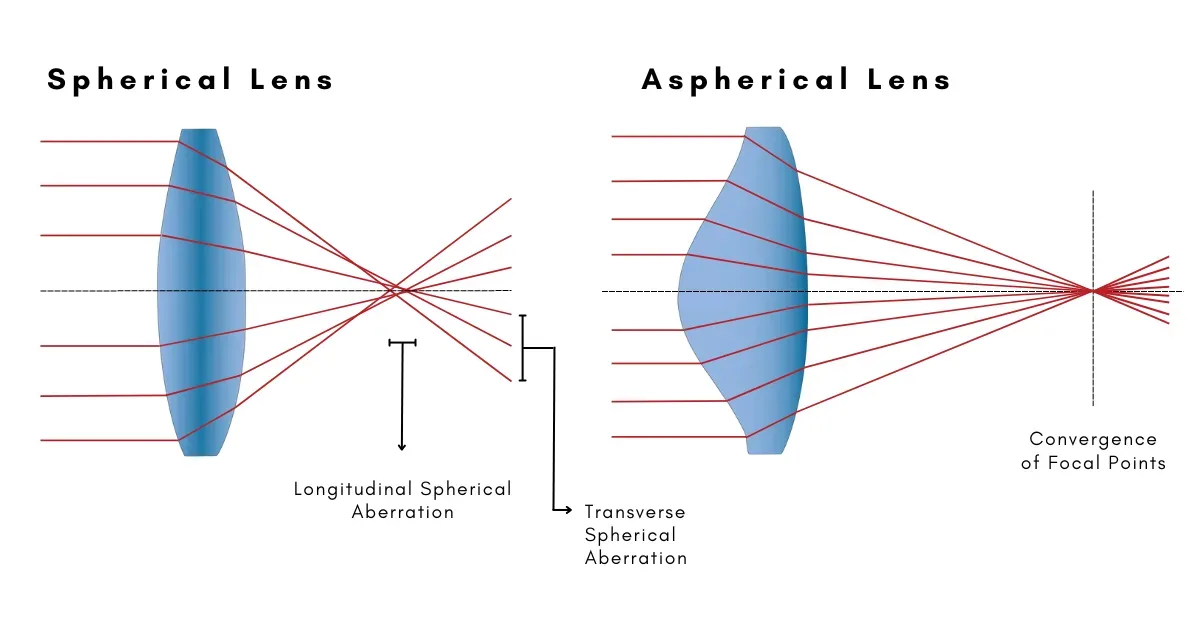
Aspheric lenses replace the constant curvature of a spherical surface with a profile that changes across the aperture. That varying curvature lets a single element correct spherical aberration that would otherwise take two or three spherical lenses to cancel. Whether you’re focusing a fiber laser onto a cutting nozzle or tightening the spot in a drilling head, an asphere gives you a sharper focus with fewer parts in the beam path. Wavelength Opto-Electronic manufactures aspheric lenses in visible, near-infrared and infrared substrates, and builds to your specification when a catalogue part doesn’t fit.
How an asphere simplifies your optical design
A spherical lens brings marginal rays to focus at a different point than paraxial rays. In a laser system that spreads energy away from the focal spot. In an imaging system it softens the image. The usual fix is to add elements, which adds cost, weight, length and more surfaces to align and coat.
An aspheric surface is shaped to bring those rays to a common focus, so you can do the same job with fewer lenses. The result is an optical assembly that is lighter, more compact and less expensive to build. Aspheric designs can also support a wider field of view than an equivalent spherical layout, which helps when you’re working with scanning or wide-area optics.
Because the performance depends on how accurately the surface profile is made and how well it is centered, form and centration are controlled tightly. Focal length is held to ±1%, and diameter and thickness are held to ±0.01mm. The full set of tolerances is listed in the specification table on this page.
Materials and coatings
The right substrate depends on your wavelength and power level. Aspheric lenses are available in:
- Fused silica, including Suprasil 313 and Corning 7980, for ultraviolet through near-infrared work and high-power fiber and solid-state lasers
- Silicon and germanium for infrared systems
- ZnS and ZnSe for infrared lasers and thermal imaging
- Chalcogenide glasses for infrared imaging optics
The standard antireflection coating is specified for the common fiber laser band, at R<0.2% per surface @ 1030-1090nm. If your system runs at a different wavelength, or needs a specific coating type, the coating is supplied to your requirement.
Applications
Aspheric lenses are used wherever a tight, well-corrected focus matters:
- Laser cutting: focusing optics in cutting heads for sheet metal fabrication and industrial manufacturing
- Laser drilling: small, clean holes in metals, ceramics and semiconductor materials
- Laser engraving and marking: consistent spot quality across the work area
- Laser welding: controlled energy delivery for automotive, battery and electronics assembly
- Solar panel scribing and grooving: precise line definition in photovoltaic production
The same aberration correction benefits imaging and beam-delivery systems in machine vision, semiconductor processing and medical equipment, where you need a compact optical path without giving up image quality.
Why buy through Wavelength Optics USA
Wavelength Optics is the US arm of Wavelength Opto-Electronic, so you can work with a local team instead of coordinating across time zones. US engineers and buyers get:
- Local support from a team that understands your application and your procurement process
- Fast quoting on catalogue parts and custom designs
- Technical consultation on selection, including help choosing substrate, focal length and coating for your wavelength and power level
If a catalogue lens is close but not right, customization is available. Send your specifications through the RFQ form, including wavelength, focal length, diameter, material and coating, and the team will come back with a recommendation and a quote.
Need Help Choosing the Right Model?
Our photonics specialists can help you select the optimal configuration for your system. Custom specifications available on request.